Thursday, October 17, 2019

Housekeeping

I'm not sure what the topic of this post will be but I'll call "housekeeping" to borrow a Sam Harris usage.

So I've been trying to play a classical 15+15 game a day and sometimes throw in a blitz or rapid here and there. I believe I am 5 games away from getting to my magical 200. I've won a few, drew one or two that I shouldn't have, and lost some to higher-rated players. Anyway I'm still focusing on analyzing and learning stuff from every game.

Beyond playing games, here's how I've been studying the "four areas" that I laid out in an earlier post.

OPENINGS

I was trying to memorize some classical lines and othe rpopular openings from that spreadsheet I made. I was doing pretty well in the open and semi-open games (not sicilian yet though) when I sorta decided to halt that some. But I was able to do a lot of it at work, for which I'm pretty grateful.

TACTICS

I'm still trying to do some of the chess.com tactics every day. My puzzle rating on that is in the mid-2000s and I'm pretty proud of that. I attribute that to my idea to spend at least 10 minutes on the puzzle if I need to. They are noticeably tougher but fun to think through, and very satisfying if I get the right answer. Beyond that, I have Polgar's 5334 Chess Problems always pulled up on my work computer and in downtime I might do a page or two of those. I'm currently on the mate-in-two section. I still have it in the back of my mind to try a spaced repetition routine on this book at some point. It's a treasure trove of pattern recognition.

I'm also going through some of Dan Heisman's videos on youtube--I strongly recommend those if you haven't checked them out--and he mentioned one of his favorite chess books is called "Winning Chess Exercises for Kids." I managed to find a copy and, well, aside from the childish delivery of the material, it is actually a pretty great book. It's more or less 100 pages of worksheets. Each worksheet has nine problems and one short question for fun. It's three rows of three positions each, the first row being three mate-in-X problems, the middle row are material tactics, and the final row is three "find the best move" positions which might be strategical or defensive and it looks like the final one in the row is always and endgame position. As usual, I have a spreadsheet going at work where I record my answers for a page then grade myself and mark in red those that I got wrong so I can review at the end. I'm finding it pretty simple yet I still miss one here and there.

MIDDLEGAME/STRATEGY

I finished the reading and note-taking for Silman's Amateur's Mind but I haven't got through all the positions in the end of the book. I still want to go through all those at least once, but he goes through the entire game so I keep thinking it'd be more beneficial to play the whole game through since he gives more notes on it. Hard to do that at work.

I'm also trying to analyze my games with the middlegame strategies in mind but I think I need to focus on pawn structures more as I've allowed worse structures for myself in many games.

Another idea is to play through annotated master games, as Dan Heisman said that's one of the main reasons he thinks he reached NM so fast.

ENDGAMES

I read through Part 4 of Silmans Endgame Course but I must go back through and take more notes. There was a LOT of good information in there and it is the longest chapter in the book. I also need to practice more pawn endgames. I fucked up one in my most recent 15+15 game and it went from winning to drawn to losing and back to drawn. I was up a pawn, and....yeah I was thinking draw the whole time. Lame. So frustrating.

I need to begin practicing basic endgames against the computer.


Things TODO

Continue going through the tests in the back of Amateur's mind (ideally I go through them a second time more thoroughly). 

Do the 4-moves-at-a-time visualization with some famous games (see "visualization practice" post).

Go through Part 4 of Silman's Endgame Course and take notes.

Start to practice endgame positions that are provided in lichess' mobile app and in Bernd Rosen's endgame book I have.

Do a few pages from "Winning Chess Exercises for Kids" a day.

Work on 5334 problems.

Continue watching Dan Heisman's videos

I recently bought his book "Most Instructive Amateur Games" (Something to that effect) and I will start working through those games on my physical board at home.

Try Heisman's "20-minute drill" where you pull up a random position from a master game, assess it, find candidate moves and decide on one. Key is to take exactly twenty minutes on the position before finding your move. I can also do this with the 25 positions in the end of amateur's mind actually.

Take a deeper look at this online book: https://archive.org/details/Simple_Chess_New_Algebraic_Edition

Friday, October 11, 2019

Finding Crutches in the Darkness

Crutches in the darkness?!

Wow, that sounds like my next goth-metal project. Or a novel. Or...something.

I'm doing some endgame study and I'm finding that a good foundation on which to build endgame knowledge is to look for "crutches" to help you navigate the darkness. Haha that sounds dramatic. Well it's also dramatically soul-crushing to let an endgame slip away that you later discover was winning. In his Complete Endgame Course, Silman was discussing the trebuchet idea when he first mentioned that knowledge of it can serve as a guide to help you in a rather confusing pawn vs pawn endgame. He says that if you can safely get to a position leading to the trebuchet and you understand the inherent zugzwang in the trebuchet position then you might be able to tell if a frozen pawn vs pawn endgame might be winning. Therefore, where you'd normally be stumbling through the darkness, all of a sudden you fumble around and see this crutch and you can stand! And get to a winning endgame! 

Silman says 
"The idea of something definable which can help us understand the right path in seemingly tough positions is an important one."
A crutch is a piece of knowledge or understanding that you can rely on to help you achieve a goal. 

It is the definable thing in a position you can point to and say, "that's winning" and I think it's extremely valuable in navigating basic endgames for beginner players.

The most basic example is "knowing how to mate a lone king with a queen." Granted this is a simple one and it is chapter one stuff of any beginner endgame book but it's a crutch nonetheless, one of which some don't know. But if you know it, and you find a position that can lead to a queen-up endgame, you'll jump to it immediately. Obviously!

Other crutches might be basic opposition, trebuchet, the square of the pawn, the deep freeze, the Lucena position. They're little patterns, positions, or techniques that one must know. They give you building blocks and positions to strive for, so that if you find one of those crutches, you can use it to win or more often to find another crutch that leads to another that leads to a win.


If white moves, you see he cannot save his f4 pawn, so black will take it regardless and have his king in front of his pawn with white's king not in any position to defend. After a few more king moves, you should see that black's king will be able to control the queening square. It's a simple, definable idea.

You can look up more information on the trebuchet but the point of this post is more broad than that. If you can memorize that position and the reasons why it's a dead loss for whomever has the move, then you've acquired a new "crutch" you can use!

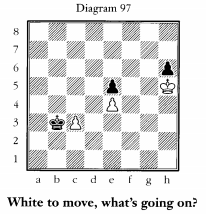
Look at this example from Silman's Complete Endgame Course:


So, what's going on? For a beginner, it looks pretty messy, maybe even a draw. And therefore one might begin just making random moves like taking the pawn and then trying to get back to the center. But with a few moves of calculation and newly acquired knowledge of the trebuchet, you might see that black should be able to make contact with the frozen pawns first, thus threatening to take. So white must react and when he does, he'll force the trebuchet onto himself.

1. Kxh6 Kxc3
2. Kg5 Kd3!
See why 2. ...Kd4 doesn't work??? After 3. Kf5 black is on the ugly side of the trebuchet. 2. ...Kd3! is the move.
3. Kf5 Kd4!

And here we've reached the trebuchet "crutch" which you know is winning for black because it's white to move and he is in zugzwang. If this wasn't in black's toolbox, he'd probably lose because he'd play the natural-looking 2. ...Kd4? and let white get the winning trebuchet position. But instead, black wins the pawn but also the game because black immediately gets the more dominant king in front of its pawn, which is another crutch. In other words, from the darkness of the endgame jungle of Diagram 97, we found these two crutches we're familiar with (trebuchet and dominant king) that helped us stand up and walk to a winning game--due to yet another crutch of how to mate with queen vs lone king! You might realize you start avoiding mindless moves like 2. ...Kd4? and you're more aware there are winning moves and losing moves in otherwise seemingly simple positions.

Lastly, here's one more very simple one. Silman refers to it as the deep freeze:


If white to move, he could play a5 which freezes black's pawns for the time being. So here we have one pawn stopping two! Obviously, depending on king positions, there may be a better move but this example serves to show how simple some of these ideas can be. In fact, many crutches can be simplified to two- or three-pawn positions on very small areas of the board. Here's the deep freeze in its most basic form:


And that might be all you need to win! Maybe in one of your endgames you have an outside passed pawn that black has to deal with, and on the other wing you can push one pawn to freeze two, then use the "fox in the chicken coup" crutch to win the game! See how we're chaining these ideas together? Deep Freeze-->Fox in Chicken Coup-->Control Queening Square-->Queen vs Lone King Checkmate Pattern. It makes calculating endgames much simpler.

Conclusion

So, for me, this is one major point of studying endgames for my level. I want to build endgame knowledge from these building blocks. They still require accurate calculation and visualization to see if you can get to a position to utilize some of these crutches, but the more of them you have in your toolbox, the better! So make it a point to acknowledge as many of these building blocks as possible.

Tuesday, October 8, 2019

Visualization Practice

Good visualization exercise using a real board! I saw this video posted on reddit:

https://www.youtube.com/watch?v=u0fQF8Ula5Q&feature=youtu.be

It gave me an idea to do this with some popular classic and romantic-era games:

1. Read out or be fed four moves at a time (i.e. 8 half-moves).

2. Visualize what the board will look like after that until you're absolutely sure you have it in your head.


3. Quickly move the pieces where they need to go. Maybe to avoid rote memorization of move order, play off the visualized position in your head. And you could move white pieces first, then black.


4. Continue with four move sets.


5. At some point you'll reach your mark you put in the list where you'll do another 4 moves and then you should prompt yourself to find the mate, just like they did in the video.


6. As you progress to new games, try 5 moves at a time, then 6 moves, etc. At some point perhaps your goal could be to pick out classical miniature games that had mate on the board (or that you know ended with resignation because mate-in-X moves), and visualize the ENTIRE game up to the point when mate was inevitable and ask yourself to write out the moves leading to mate.


Obviously, in step 5 I referenced a "mark" where you prompt yourself to "find mate-in-X" or "find the tactic to win material" so this requires some planning ahead so you'd have to find some classic games where mate or a good tactic was forced and/or played out.

Here's a start for some famous games to consider doing:

https://en.wikipedia.org/wiki/List_of_chess_games#cite_note-49

Thursday, October 3, 2019

An Idea for Openings

I'm still following the advice of "Don't memorize openings until XYZ rating" but I do want to start learning how to identify most popular openings. It started with a reddit post listing a ton of openings with both names and moves. I took that and ran with it. It had its share of errors so I made my own (part of my DIY-approach to improvement). From that reddit post, I took any of the opening names that I had at least heard of and put them in a spreadsheet. I added in a bunch of other variations that I thought were worth knowing or looked popular. Then using wikipedia and lichess (sidenote, you can also open the mobile app>Menu>Board Editor>Gear Symbol> and choose an opening to see the first moves), I populated all the moves for the openings I chose. I ended up with 89 openings.

I wanted to memorize them so I could say, "here's a Caro-Kann Advanced Variation" or "This game started with a Sicilian Rosslimo." It could be a launchpad into exploring the openings further down the line, or it could just help in communicating about chess in general and following commentators more easily.

Anyway, here's an image of my spreadsheet.


The actual spreadsheet has more columns for things like general ideas, external resources like youtube links on a given opening, tricks and traps, and common continuations. I'm slowly adding to that but my first objective is to memorize the names and moves of these 89 openings.


How to memorize?

I spend a lot of downtime at work (there's a lot for me) on chess stuff. I figure this is a good time to study openings, at least the basic opening moves, since it's pretty much an excel sheet with text so I don't have to have a chess site open or stare at lichess on my phone which might look suspicious to fellow co-workers. One caveat is that I had some portion of this list already known from my time playing some of the openings and also from putting the list together in general. Like they say in college, sometimes just writing the notes is enough to help you begin learning.

Here's my old school way of memorizing at work:

1. Pick a subset of the openings (like the e4 section for example). Re-acquaint yourself with each one, basically just read through each line. Like cramming before the test.

2. Then start at the top, hide the name column and for each line, read through the moves and write/type in a .txt file the name of the opening. Example: e4, e5, Nf3, Nc6, d4....is the Scotch Game.

3. Check over what you did in step 2 for errors. Take note of the ones you're struggling with.

4. Now go back through but hide the moves this time. For each opening name, mentally recite the moves.

5. Go through the subset a third time, hiding the moves again. For each opening name, write/type out the moves. 

6. Check your work noting the ones you're still struggling with.

7. Move on to other subsets until you've gone through the entire table. Then start fresh again but make your subsets larger. And pay special attention to the ones you've had a hard time memorizing. Feel free to take out the ones you absolutely know by heart. Consider using a real chess board at home to shake things up.

Eventually you'll have them all memorized. It will probably help to shuffle up the order of the subsets as you're going through this, and eventually shuffle the order of the full list of your openings.


Ideas for more study

* Pull an opening out of a hat, play through the moves on lichess' analysis board, and guess the most popular continuations from the opening database. 

* Add a column in your spreadsheet for "General Concepts" and use various resources to find out the common themes in each opening such as where the pawn break is, what files usually open, if it often leads to a minority attack, etc.

* Find a famous example of a game for each/most openings and play through it, annotate it, memorize it, etc.

Friday, August 30, 2019

Four Areas To Study

From my perspective right now, there are four core elements to a chess game that one can study:

Openings
Middlegame Strategy
Tactics
Endgame

I'm not going to spout off how I think everyone should balance these out but I want to outline what I consider good baseline knowledge/skill and the goals I have for each.

Openings
I want to be able to identify an opening from the first 3-5 moves, so long as it's not some obscure opening. If I see a rossolimo sicilian, a catalan, or a hedgehog I want to be able to say that with confidence. I don't think it's quite valuable yet for me to know the deep plans for each and the 12th move of all variations but if somebody plays c5 to my e4, I want to know two or three good options and what they're called. I think it's good to have that baseline knowledge to springboard my study. 

I'm using a reddit post that outlined a bunch of common openings with anywhere from 2 to 5 moves per side. There were a lot of errors but I corrected them and made my own spreadsheet with all moves and the common name of the opening. I've also been adding to that a quick note for memorization. For Evans Gambit for example, I'd write "giuoco piano then b4 from white." I hope to slowly memorize them and be able to belt out the moves on a board. I also want to add in a column for "General Plans" as I go, such as "trade off the light squared bishop and fight for d5" or something similar.

Middlegame Strategy
It's the "What do I do now?" problem. I will have to continue reading The Amateur's Mind for the time being and keep taking notes on it. Equally important, I'll have to analyze my games and master games with these ideas in mind and take note of when I made a good analysis of the position and when I didn't. If I can get out of the opening 49 times out of 50, this and tactics are the things I need to work on most. To work on this though, is a matter of reading material and applying it to my games which is a more typical version of studying I did in school where you're memorizing key concepts until you can apply them in your games (similar to memorizing concepts to apply to an essay or test in school). Therefore this can seem to be a little dry and feel more like work which might be the reason for my avoiding it. Whereas tactics are easier tests that I can do in a few minutes on a phone app....

Tactics
As I've just got back into chess in the last few weeks I've started playing a LOT of tactics apps and using webpages. It all started a month or so ago when I got the Play Magnus app again. I just began playing him at his youngest age to make myself feel better. Then I decided on playing him until I got to 500 points then I'd jump to the next age level. The first few were easy but I'm currently stuck on age 9. If I work hard, I can draw him but I haven't won yet. Anyway, the point is that I made up a little game within the game where I have a goal of a number of points to get to. And that's how we get to tactics. Find a way to turn it into a game to watch your progress over the course of many days, weeks, months. Like what I did with the woodpecker method. 

Right now I have an app called "Chess Tactics Pro" and it's just like any old tactics trainer. I dove in and saw that it has 150 "easy" puzzles so I instantly decided I'd solve them all, then go straight back and solve them again, and again and again until I could do it in 20 minutes or so.

Make up games like this and do them. It helps stretch your training over the course of many days or weeks until next thing you know, you're doing tactics every day....which is the idea!

Endgame
Again, like middlegame strategy this is a fair amount of just intaking and memorizing knowledge like how opposition works, how to advance a majority, the lucena position, etc. I am oddly not confident in how opposition works and I don't know why. If the king is in front of the pawns I feel good in telling you if it's winning or not but I need to be able to see this from further out and if the kings are in weird positions (like not in or close to direct opposition). I was given a pdf book called Chess Endgame Training by Bernd Rosen and I recall looking at it briefly a few months ago. It seemed pretty helpful and had loads of examples so I should re-visit that. And continue going through Silman's Endgame Course. 

Conclusion
Lastly, it's a matter of playing games and analyzing. And of course making sure I'm using the lessons learned in my tactics training, middlegame and endgame strategy, and opening knowledge to an extent. I think with all these core elements, one could devise a decent study schedule such as Monday is tactics, Tuesday is opening, Wednesday is middlegame, etc. I don't know if I'm organized enough to do that but perhaps I will continue my tactics training hard (1-2 hours a day I think is pretty good) and begin mixing in endgame stuff, Silman's Amateur's Mind book, and random opening memorization which I can probably do during slow times at work.


Wednesday, August 28, 2019

I bought a chess set

I don't really have anyone to play with but FUCK IT! I've always wanted a nice set of weighted pieces so I went out and bought some. There is a chess board on its way as well. I figured I'd start with the pieces as that selection would be more subjective to my personal tastes and I could play with them on my crappy vinyl roll-out "board" to find out exactly what square size I'd need for a board. Plus I could be more flexible in my choices instead of buying a "set" with both pieces and board in one price (that was usually higher).

Shortly after checking amazon.com, I discovered that I really like the aesthetics of a set that I began to see referred to as the "Leningrad." Who knows if that is an accepted name, but it was the knight in particular that caught my eye. Its bowed head looked honorable and respectful as opposed to the more traditional knight I've seen with its head pointed forward.


I ordered them from a store called Staunton Castle and it shipped from India. The packaging was great and the pieces feel amazing. Nice and weighty. Substantial. Good felt on the bottoms.

The one set I had when I was younger was a cheap magnetic travel set that had approximately 1 inch squares. I bought a vinyl and plastic tournament set two years ago and I was surprised at how much larger the pieces were. It took me many games to get used to the size. The board alone was about 21 inches wide! Quite different compared to the travel set. I started to see that the chess pieces the professionals play with are quite large as well and most of the quality sets for sale online are similar size. The king in my set is around 4 inches tall and the base is about 1.625 inches. I got the ebonized set so the black pieces are quite dark. Thanks to amazon points, I only had to spend $81.78 on these pieces.

For the board, I decided to go for a 2.25 inch square to match the vinyl board I'd been using to practice. I found that boards looked too crowded if you didn't get a large enough square size. Between watching the 2019 Sinquefield cup on youtube and reading comments about the board (the table is amazing) and also getting inspiration from /r/chessporn, I was settled on a 2.25 square. Then of course is type of wood, color, border, etc. I didn't want a huge border and I wanted completely solid wood but those are hard to find and expensive. Most options were veneer but reviews sounded good so I settled with chessusa.com.

I went with a mahogany board. Click here to go to the store's page. As for price, I took advantage of Chess USA's new customer discount and only had to pay $103.96.

I will post a picture of the board and pieces when I put everything together!

It is a bit overkill since I rarely play anyone OTB at my house but I'll be super excited to see this on display and to use it for practicing opening memorization and playing through master games.


Friday, August 16, 2019

Slow Rapids

So my new idea is to play more rapid. I want to get to 200 classical games still, but also I'd like to focus on my rapid game which will presumably give me a lot more games to play and let me focus on just GETTING GAMES IN! So I want to find out the slowest possible time control on lichess that still is classified as "rapid." I found this information on lichess' message board:

Assuming a time control of M minutes with S increment in seconds:

1 M = 60 seconds
1 S = 40 seconds

Basically, for every base minute add 60 seconds and for every increment-second, add 40 seconds. You'll use that sum in conjunction with this table to get lichess' time control classification:

0:01-0:29 = Ultrabullet
0:30-2:59 = Bullet
3:00-7:59 = Blitz
8:00-24:59 = Rapid
25:00+ = Classical

Let's say you have a 5|5 game That's 5 minutes of game time plus 5 seconds increment per move, or 5M + 5S. From the above assignments, that would be 5*60 + 5*40 = 500 seconds, or 8:20 which fits under the rapid category.

So my quest is to know all comfortably slow time controls that are still considered rapid in lichess. This way I can still take as much time as possible even though they're technically rapid. I'm reeeeally trying to find every edge, probably for little actual value ;) So I have to get as close to the 24:59 sum as possible. Let's just shoot for 25:00 to simplify the math then I can drop a second of increment to get within the range. 

Let's start with a base of 10 minutes. That would give me 15:00 more to work with to calculate the increment time. That's 900 seconds and if I divide that by 40 to get the necessary increment, it's 22.5 so we have to say 22 seconds. So with a base start time of 10 minutes, I can do a maximum of 22s increment to stay within rapid. I'd imagine after playing a few quick opening moves, a 10|22 game wouldn't feel wildly different from a 15|15 game that I'm more used to.

I did a few more so here's an overview for rapid time controls that would be on the extreme slow end. This should be read as base time plus the maximum increment that will still classify the game as rapid:

5|29 (minimum of 5 seconds of increment)
6|28 (minimum of 4 seconds of increment)
7|26 (minimum of 2 seconds of increment)        
8|25 
9|23
10|22
11|20
12|19
13|17
14|16
15|14
20|7

Again, 5|29 is rapid, but if you play a 5|30 game, that is technically classified as a classical game! I'll grant that this chart is a bit specific because, most probably, you won't find a lot of 6|28 games. But it is helpful for those more common 5, 8, 10, 12, or 15-minute base games that pop up in the lobby. So if you see a 5|25 game available, you'll know that's technically a rapid game! Or a 10|20, 12|15, 15|10, or 20|5 game! 

So in conclusion, since I'm going to start working on my rapid rating, why not try to milk as much time as possible for these games?! I mean technically a 5 minute game with 5 seconds increment is rapid, but if there is a 5|25 game available too, isn't it good to know that they're both classified as the same type of game?! Oh well, this at least wasted some time for me at work....

My SECOND OTB Tournament Experience!

Allright, it's time for another tournament! Six months since my last one, no thanks to a certain variant of a certain virus which shall ...