Showing posts with label Endgames. Show all posts

Friday, March 6, 2020

Find a Win

I heard Stjepan Tomic (from popular youtube channel "Hanging Pawns") on an episode of the Perpetual Chess Podcast describing how he analyzed his losses. He said one of the stages is to always try to find a win--a critical point where if you played the right moves, you would have won the game or a decisive advantage. I thought that was a great idea and it certainly makes losses a little easier to accept when you can take very specific lessons from them. From analyzing my fourth OTB game in the monthly tournament at my club, I got a great lesson in pawn endgames. I made a big reddit post about it but I'll paste the majority of that here with some minor edits.

The starting position:


I'm playing white and I'm moving my pawns upwards. Black just played Kc4 and he's made it very clear he's going over to capture my queenside pawns. I played Ke3?? in this position. This was the critical moment to take some time and work out my plan. Instead, I allowed black to dictate play and just follow him to the queenside in hopes that I could figure out a way to leave him with a rook-pawn and get a zugzwang or stalemate trick or that he misplays something. I got lucky because he did misplay and I got a draw but the point is that I did not find the winning idea--so I'll do that now.

It's a pretty common endgame: I'm up a pawn but there are a lot on the board so there are many options of what push, there are decisions on when and how to get active with the king, how to make a passed pawn before my opponent, how fast my opponent really is, if there are tactics, etc. I was up something like +2.0 in the engine evaluation until I played Ke3. I capitulated and followed his king around when I should have taken some time and counted out a pawn race. How am I supposed to figure that out in the game with the clock ticking down? Here's how:

Black's plan is to capture my queenside pawns and then push his own. Do I have enough time to let him freely do that while I try to push my kingside majority and make a passer there? It sure looks like I have a lot more steps to accomplish my plan compared to him but we don't know unless we count.

Look at the starting position again. If left alone, Black can queen with these eight moves:

Kb3, Kxb2, Kxa3, b5, b4, b3, b2, b1=Q

So eight is a number we should keep in mind.

Can white make a passed pawn on the kingside in that time? White must either get his king in to help his pawn advance or advance the pawns on their own. White should see that his king will take three moves to get into an active square (like g5) so that seems painfully slow. Regardless, three advanced connected pawns should be able to queen against two isolated pawns without the king's help--which is the situation on the kingside. That is one of the main principles at play. We must calculate if we have time to do a pawn storm. Remember you have eight moves before black queens but white is on move. Soooo start counting:

(The first move is very nice as it freezes blacks' kingside pawns, a nice trick in pawn endgames)

g5!, f4, h4, f5, h5, g6!

The breakthrough! You should STOP HERE since you got to a critical point now that you see some forcing situations--like pawn captures or decisive pushes. This is white's sixth move, so I find it helpful to check in on where black's king and pawns would be at this stage. So again, white just played his sixth move, and since white is on move in the starting position, we can play six moves and black would be on his fifth. Here's what you should be able to visualize:


This should be a sort of "checkpoint" you can keep going back to when you're calculating the upcoming critical moves. We got to this checkpoint by a simple count of pawn moves. You can see that black can either ignore the g6 move and push b4-b3 or capture it with one of his pawns. Importantly, you must see that white has his choice of queening square regardless:

If black completely ignores and plays b3 then white has his choice of how to promote: either g8 via a simple g6-g7-g8=Q, or white can promote on f8 or h8 via a capture onto either of those files. This is when you might notice that you can queen with check if you do it correctly, since black's king is exposed on a diagonal! Of course, if black captures on g6, white can still work it out to promote with check or with enough time to check the black king before black gets his pawn close enough. And know that if black ever took a move to get his king off the a3-f8 diagonal like moving his king to a4, that's a waste of a tempo and white will win that way too.

When you start to see these dynamics at play, you should start seeing some hope and a path forward and then re-calculate all various options black has.

So from the beginning, one such example would be:

1. g5!  Kb3
2. f4  Kxb2
3. h4  Kxa3
4. f5  b5
5. h5  b4

That concludes the first part of the simple race calculation (call it a checkpoint if you'd like) which should be the basis of your critical calculations. Remember the shortcut to do that is to count the number of moves each side has to get to a position in your head. An inner dialogue I might have up to this point is:

"So after five moves I can visualize white with all three kingside pawns on the fifth rank while black has gobbled up my queenside with his king, which sits on a3 and his pawn on b4. It's my move."

I use that shortcut to easily visualize the board after the "forced" race-like moves, which would help me find the critical breakthrough move:

6. g6!  hxg6
7. hxg6  fxg6 (f6 8. g7  b3  9. g8=Q  b2  10. Qf8+)
8. f6  b3
9. f7  b2
10. f8=Q+

A queen vs king and pawn on the 7th rank (second rank technically) is almost always winning for white (rook- and bishop-pawns are exceptions). Make sure you know the technique! I do and that would have been a lovely way to end this game but alas I didn't take the time to calculate the pawn races and breakthrough leading up to it.

* * * * * * * * * * * * * * * * * * * * 

I hope you can follow all that. On the reddit thread, someone posted a link to a nice Ben Finegold lecture about breakthroughs and I found this position illustrative--Sorry about the youtube bar at the bottom ;). White to move:


From: https://www.youtube.com/watch?v=5XFCp5XDwuM

White wins thank to the more advanced position of his pawns. His pawns are on the 4th and 5th ranks while black's are on the 2nd and 3rd ranks (relative to each player's perspective) and that makes the difference. The idea is that white will give up some pawns to get a very valuable passed pawn that will promote before any of black's pawns. It's really just a slightly different version of the most popular breakthrough position seen below:


You should know that position. The idea is the same: with best play, both sides will have passed pawns but white's will be more valuable because it's more advanced and thus will promote first with enough time to gobble up any of black's pawns. If I saw these ideas of advanced pawn majorities and breakthroughs, I would have won my game. Live and learn!

Friday, October 11, 2019

Finding Crutches in the Darkness

Crutches in the darkness?!

Wow, that sounds like my next goth-metal project. Or a novel. Or...something.

I'm doing some endgame study and I'm finding that a good foundation on which to build endgame knowledge is to look for "crutches" to help you navigate the darkness. Haha that sounds dramatic. Well it's also dramatically soul-crushing to let an endgame slip away that you later discover was winning. In his Complete Endgame Course, Silman was discussing the trebuchet idea when he first mentioned that knowledge of it can serve as a guide to help you in a rather confusing pawn vs pawn endgame. He says that if you can safely get to a position leading to the trebuchet and you understand the inherent zugzwang in the trebuchet position then you might be able to tell if a frozen pawn vs pawn endgame might be winning. Therefore, where you'd normally be stumbling through the darkness, all of a sudden you fumble around and see this crutch and you can stand! And get to a winning endgame! 

Silman says 
"The idea of something definable which can help us understand the right path in seemingly tough positions is an important one."
A crutch is a piece of knowledge or understanding that you can rely on to help you achieve a goal. 

It is the definable thing in a position you can point to and say, "that's winning" and I think it's extremely valuable in navigating basic endgames for beginner players.

The most basic example is "knowing how to mate a lone king with a queen." Granted this is a simple one and it is chapter one stuff of any beginner endgame book but it's a crutch nonetheless, one of which some don't know. But if you know it, and you find a position that can lead to a queen-up endgame, you'll jump to it immediately. Obviously!

Other crutches might be basic opposition, trebuchet, the square of the pawn, the deep freeze, the Lucena position. They're little patterns, positions, or techniques that one must know. They give you building blocks and positions to strive for, so that if you find one of those crutches, you can use it to win or more often to find another crutch that leads to another that leads to a win.


If white moves, you see he cannot save his f4 pawn, so black will take it regardless and have his king in front of his pawn with white's king not in any position to defend. After a few more king moves, you should see that black's king will be able to control the queening square. It's a simple, definable idea.

You can look up more information on the trebuchet but the point of this post is more broad than that. If you can memorize that position and the reasons why it's a dead loss for whomever has the move, then you've acquired a new "crutch" you can use!

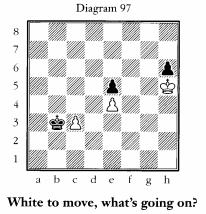
Look at this example from Silman's Complete Endgame Course:


So, what's going on? For a beginner, it looks pretty messy, maybe even a draw. And therefore one might begin just making random moves like taking the pawn and then trying to get back to the center. But with a few moves of calculation and newly acquired knowledge of the trebuchet, you might see that black should be able to make contact with the frozen pawns first, thus threatening to take. So white must react and when he does, he'll force the trebuchet onto himself.

1. Kxh6 Kxc3
2. Kg5 Kd3!
See why 2. ...Kd4 doesn't work??? After 3. Kf5 black is on the ugly side of the trebuchet. 2. ...Kd3! is the move.
3. Kf5 Kd4!

And here we've reached the trebuchet "crutch" which you know is winning for black because it's white to move and he is in zugzwang. If this wasn't in black's toolbox, he'd probably lose because he'd play the natural-looking 2. ...Kd4? and let white get the winning trebuchet position. But instead, black wins the pawn but also the game because black immediately gets the more dominant king in front of its pawn, which is another crutch. In other words, from the darkness of the endgame jungle of Diagram 97, we found these two crutches we're familiar with (trebuchet and dominant king) that helped us stand up and walk to a winning game--due to yet another crutch of how to mate with queen vs lone king! You might realize you start avoiding mindless moves like 2. ...Kd4? and you're more aware there are winning moves and losing moves in otherwise seemingly simple positions.

Lastly, here's one more very simple one. Silman refers to it as the deep freeze:


If white to move, he could play a5 which freezes black's pawns for the time being. So here we have one pawn stopping two! Obviously, depending on king positions, there may be a better move but this example serves to show how simple some of these ideas can be. In fact, many crutches can be simplified to two- or three-pawn positions on very small areas of the board. Here's the deep freeze in its most basic form:


And that might be all you need to win! Maybe in one of your endgames you have an outside passed pawn that black has to deal with, and on the other wing you can push one pawn to freeze two, then use the "fox in the chicken coup" crutch to win the game! See how we're chaining these ideas together? Deep Freeze-->Fox in Chicken Coup-->Control Queening Square-->Queen vs Lone King Checkmate Pattern. It makes calculating endgames much simpler.

Conclusion

So, for me, this is one major point of studying endgames for my level. I want to build endgame knowledge from these building blocks. They still require accurate calculation and visualization to see if you can get to a position to utilize some of these crutches, but the more of them you have in your toolbox, the better! So make it a point to acknowledge as many of these building blocks as possible.

My SECOND OTB Tournament Experience!

Allright, it's time for another tournament! Six months since my last one, no thanks to a certain variant of a certain virus which shall ...